Most business owners don’t choose their payment processing model.
It’s chosen for them.
And because of that, many merchants don’t realize that the way they’re being charged — not just the rate itself — plays a major role in how much they ultimately pay.
Two businesses can process the same volume and still have very different costs, simply because they’re on different pricing models.
If you’ve ever looked at your statement and felt like the numbers didn’t quite make sense, there’s a good chance the pricing model is part of the reason why.
Why Payment Processing Pricing Feels So Confusing
The payments industry doesn’t make this easy.
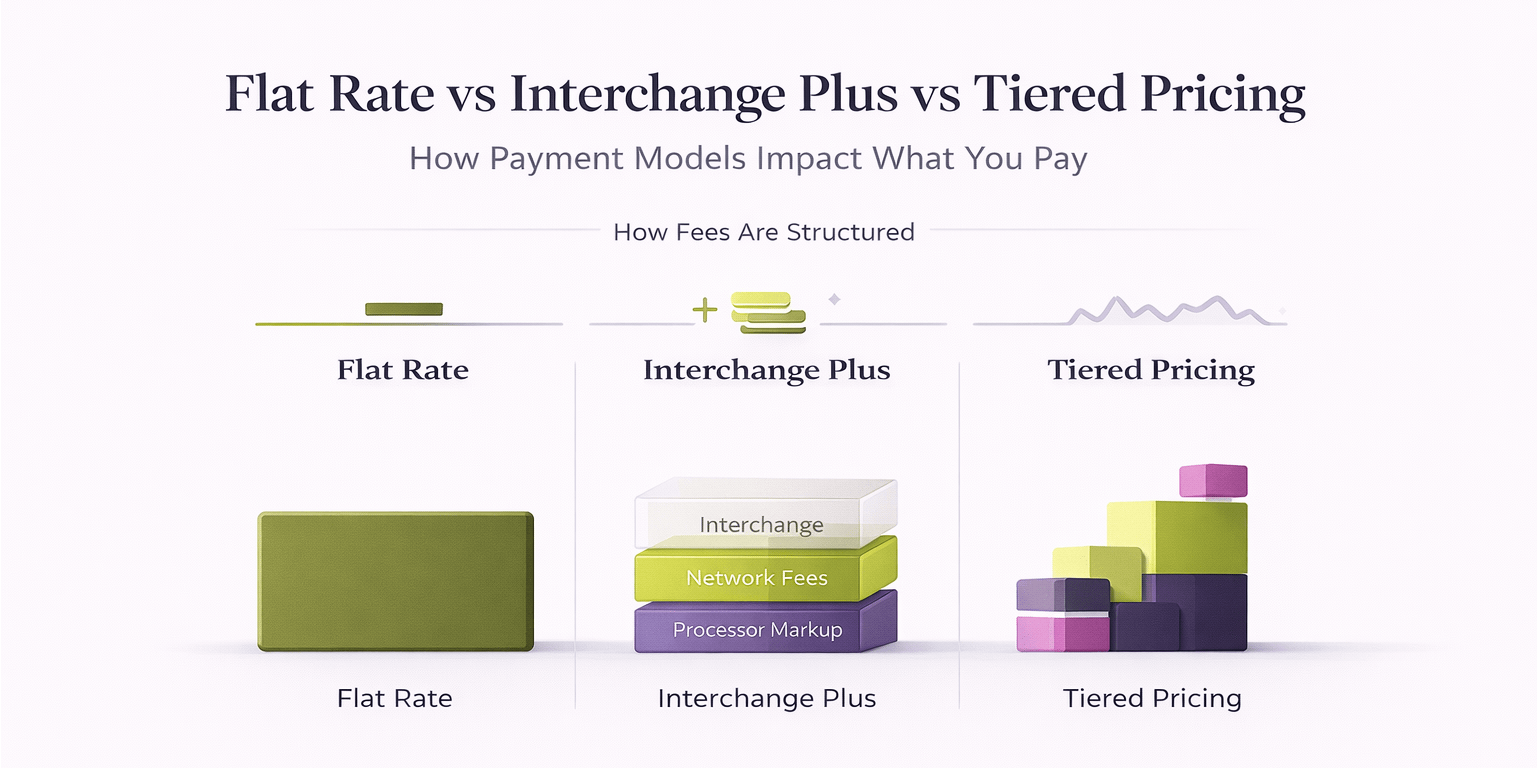
At a high level, there are three primary pricing models most processors offer:
- Flat rate
- Interchange plus
- Tiered pricing
Each one structures fees differently. Each one behaves differently. And each one benefits certain types of businesses more than others.
The challenge is that most merchants are never walked through these differences clearly. Instead, they’re given a rate, a contract, and a statement that’s difficult to interpret.
Without understanding the model underneath it all, it’s almost impossible to know whether your pricing actually fits your business.
The Three Main Pricing Models Explained
Let’s break each one down.
Flat Rate Pricing
Flat rate pricing is the simplest model to understand.
You’re charged a fixed percentage for every transaction. For example:
2.9% per transaction
That number is meant to cover everything — interchange, network fees, and processor margin.
On the surface, this feels straightforward. One rate, no surprises.
But underneath that simplicity is an important detail: the rate is set high enough to protect the processor, not necessarily to optimize cost for the merchant.
Because interchange fees vary depending on factors like card type and transaction method, processors build in a buffer. That buffer ensures they remain profitable regardless of what type of transactions you run.
For some businesses, this works well.
Flat rate pricing tends to make the most sense for businesses that process primarily card-not-present transactions, such as e-commerce. These transactions typically have higher interchange costs, so the flat rate aligns more closely with actual expenses.
For other businesses, especially those with lower-risk transactions, this model can result in overpaying.
Interchange Plus Pricing
Interchange plus pricing separates the underlying costs from the processor’s margin.
Instead of bundling everything into one rate, this model breaks it out:
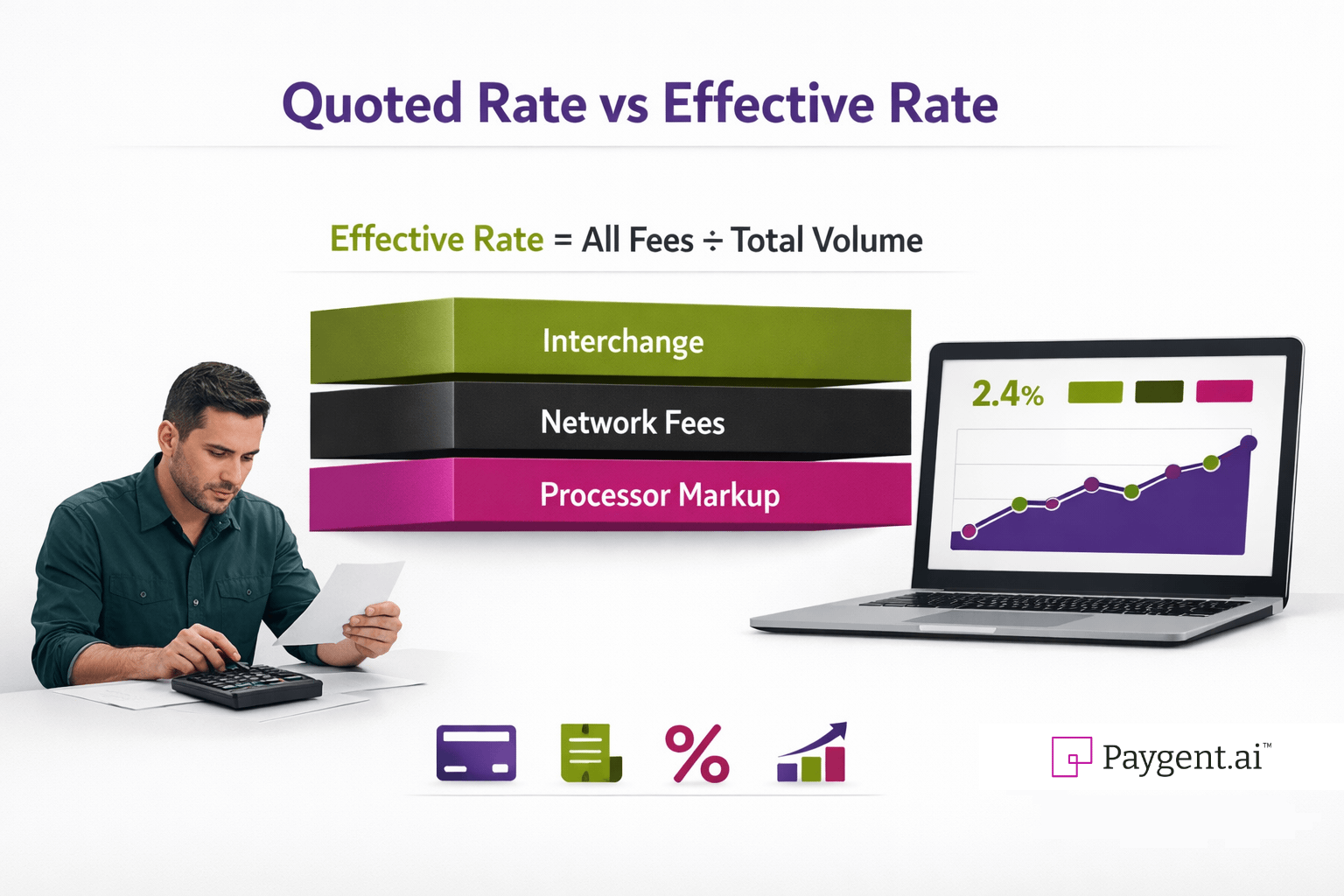
Interchange + Network Fees + Processor Markup
Interchange is the portion you can’t avoid — it’s set by the card networks and paid to issuing banks.
What changes is how the processor charges on top of that.
With interchange plus, the markup is clearly defined. It may be something like:
+0.30% + $0.10 per transaction
Or in some cases, a monthly subscription model replaces per-transaction markup.
This structure is considered one of the most transparent pricing models because it allows you to see what you’re paying and why.
Interchange plus tends to work best for businesses that process a high volume of card-present transactions, where interchange rates are lower due to reduced risk.
It can also be beneficial for businesses with larger average ticket sizes or predictable transaction patterns.
The key advantage is visibility — and with visibility comes control.
Tiered Pricing
Tiered pricing is often the most difficult model to understand — and the hardest to predict.
Instead of one rate or a transparent breakdown, transactions are grouped into categories, or “tiers.”
For example:
- Qualified
- Mid-qualified
- Non-qualified
Each tier carries a different rate.
Where it gets complicated is how transactions are assigned to those tiers.
Factors like card type, rewards programs, transaction method, and even processing volume can influence where a transaction falls.
That means two similar transactions may be priced differently, depending on how they’re classified.
In some cases, tiered pricing can work well for businesses with highly predictable transaction behavior — for example, businesses that consistently process the same types of payments from the same sources.
But for many merchants, especially those with varied customer behavior, this model introduces uncertainty.
And when pricing is unpredictable, it becomes difficult to manage costs effectively.
Why the Right Model Depends on Your Business
There isn’t a single “best” pricing model.
There is only the model that best fits your business.
The biggest factor in determining that fit is your transaction mix — how your customers pay you.
- Do you process mostly online payments?
- Are transactions primarily in person?
- Do customers use a wide variety of cards?
- Is your volume consistent or unpredictable?
Each of these variables influences how fees are applied.
For example:
- High card-not-present volume → Flat rate may be reasonable
- High card-present volume → Interchange plus often performs better
- Predictable enterprise transactions → Tiered pricing may work
What matters is aligning your pricing structure with how your business actually operates.
The Insight Most Merchants Miss
Many merchants assume their pricing model is fixed.
It isn’t.
In many cases, processors offer multiple pricing models — sometimes without explicitly advertising that fact.
That means you may not need to switch providers to improve your costs.
You may simply need to switch how you’re priced.
This is one of the most overlooked opportunities in payment processing.
Because without clarity, there’s no reason to question the model.
And without questioning it, businesses continue paying fees that don’t align with how they operate.
Why Transparency Changes Everything
When you understand your pricing model, you start to see your costs differently.
You begin to connect:
- How transactions are processed
- How fees are applied
- How pricing decisions impact your bottom line
That’s where control comes from.
And that’s exactly why Paygent.ai exists.
We analyze your transaction statements to uncover:
- Your pricing model
- Your transaction mix
- Your effective rate
- Where you may be overpaying
From there, we help identify whether a different pricing structure — or even a combination of models — could better serve your business.
Because in some cases, the optimal setup isn’t one processor or one model.
It’s a strategy.
The Bottom Line
Payment processing pricing isn’t just about the rate you were quoted.
It’s about how that rate is structured.
Flat rate, interchange plus, and tiered pricing each serve a purpose — but only when they align with your business.
If they don’t, the difference shows up in your margins.
And often, it goes unnoticed.
Until you take a closer look.
Want a Free Audit?
Request a free audit of your current payment processor statement by clicking on the button at the top of this page.
Paygent.ai will analyze your fees, identify your pricing model, and help you understand if there’s a better path forward.