Most business owners know what rate they were quoted when they signed up for payment processing.
Very few know what they’re actually paying.
That difference between what you were told and what shows up on your statement comes down to one number: your effective rate.
Understanding how your effective rate works — and why it can change from month to month — is one of the most important steps you can take to control your payment processing costs.
Once you understand it, you start to see why two businesses running the same volume can pay very different fees.
And why the quoted rate is often the least useful number on your statement.
Quoted Rate vs Effective Rate
A quoted rate is the percentage you were told you would pay when you signed up with your processor.
You’ve probably seen something like:
2.9% flat rate
2.5% processing
2.6% + 10¢ per transaction
Those numbers are easy to understand, which is why they’re used in sales conversations.
But they rarely tell the full story.
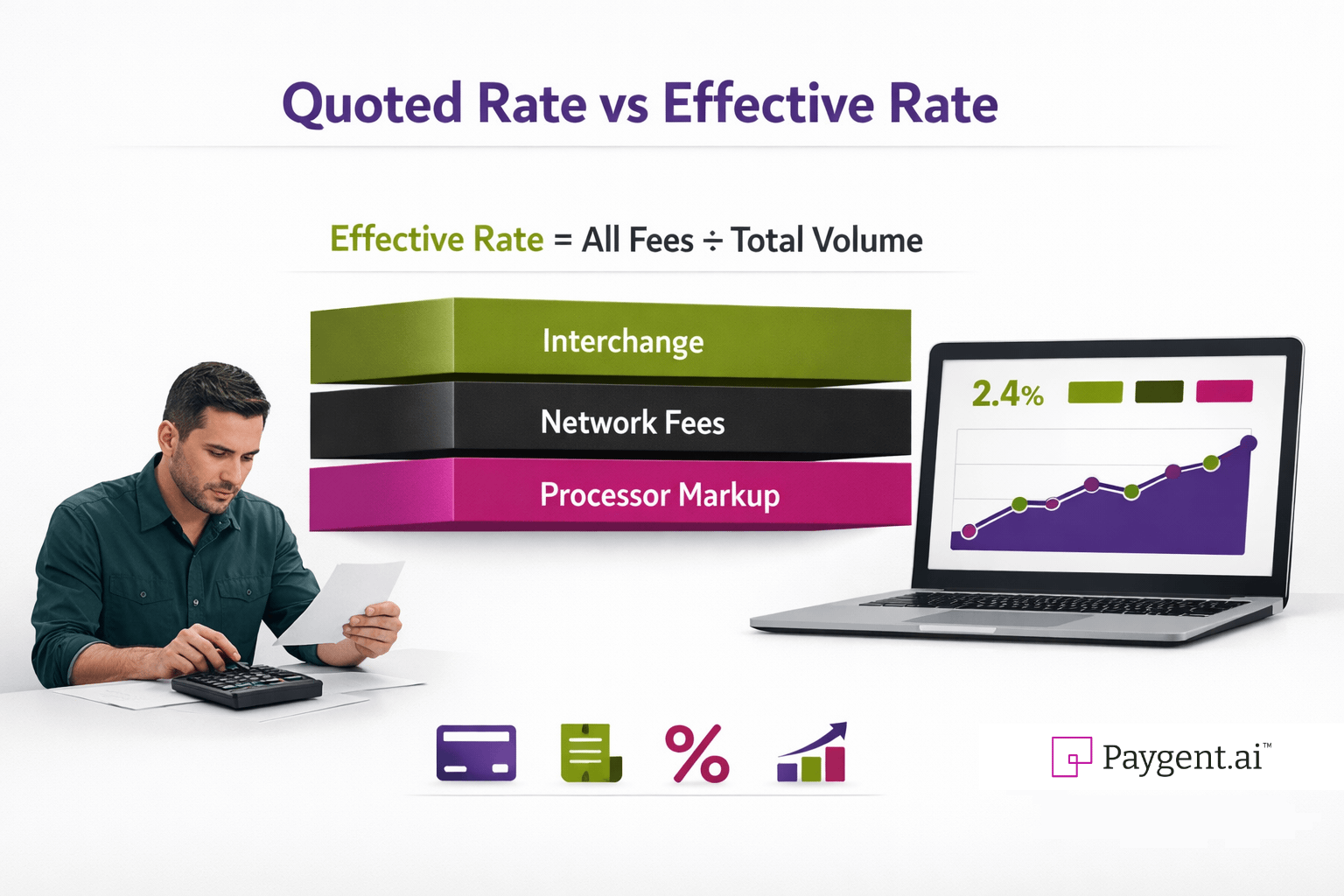
Your effective rate is the total amount you paid in fees divided by the total amount you processed.
Total fees ÷ Total volume = Effective rate
This includes everything:
- Transaction fees
- Monthly fees
- PCI fees
- Statement fees
- Gateway fees
- Assessments
- Markups
When all of those are included, the number you actually pay is often higher than the number you were quoted.
And that effective rate is the number that really matters.
Why the Payments Industry Works This Way
This idea of quoted rate vs effective rate isn’t unique to payments. You see the same concept in banking and investing.
For example, when a bank advertises a CD with a 4% rate, that’s the APR — the quoted rate.
But what you actually earn depends on compounding and other factors, which is why the bank also shows APY. APY reflects the real return after everything is calculated.
Payment processing works the same way, except in the opposite direction. Instead of earning more than the quoted rate, businesses often pay more than the quoted rate once all fees are included. That’s why the effective rate should always be your reference point.
What Actually Makes Up a Processing Fee
Every credit card transaction has multiple parts. Most business owners only see one number, but behind the scenes there are three main components.
Interchange
Interchange is the fee paid to the card-issuing bank.
This changes based on:
- Card type
- How the card was run
- Risk level
- Industry type
Interchange can vary from transaction to transaction, even in the same business. You cannot avoid interchange, but you can make sure it’s being passed through correctly.
Network Fees (Assessments)
Card brands like Visa and Mastercard also charge fees.
These are required costs for using the network.
They are usually small, but they are always there.
These are not controlled by your processor.
Processor Markup
This is the part your processor controls.
Processors are businesses, and they make money by adding margin.
That margin can be:
- Included in a flat rate
- Added as a markup
- Charged as a monthly fee
- Hidden in extra charges
This is where most differences in effective rate come from.
Why Two Businesses Can Have Very Different Effective Rates
Two businesses can process the same amount of volume and still pay very different fees. The reason usually comes down to pricing structure.
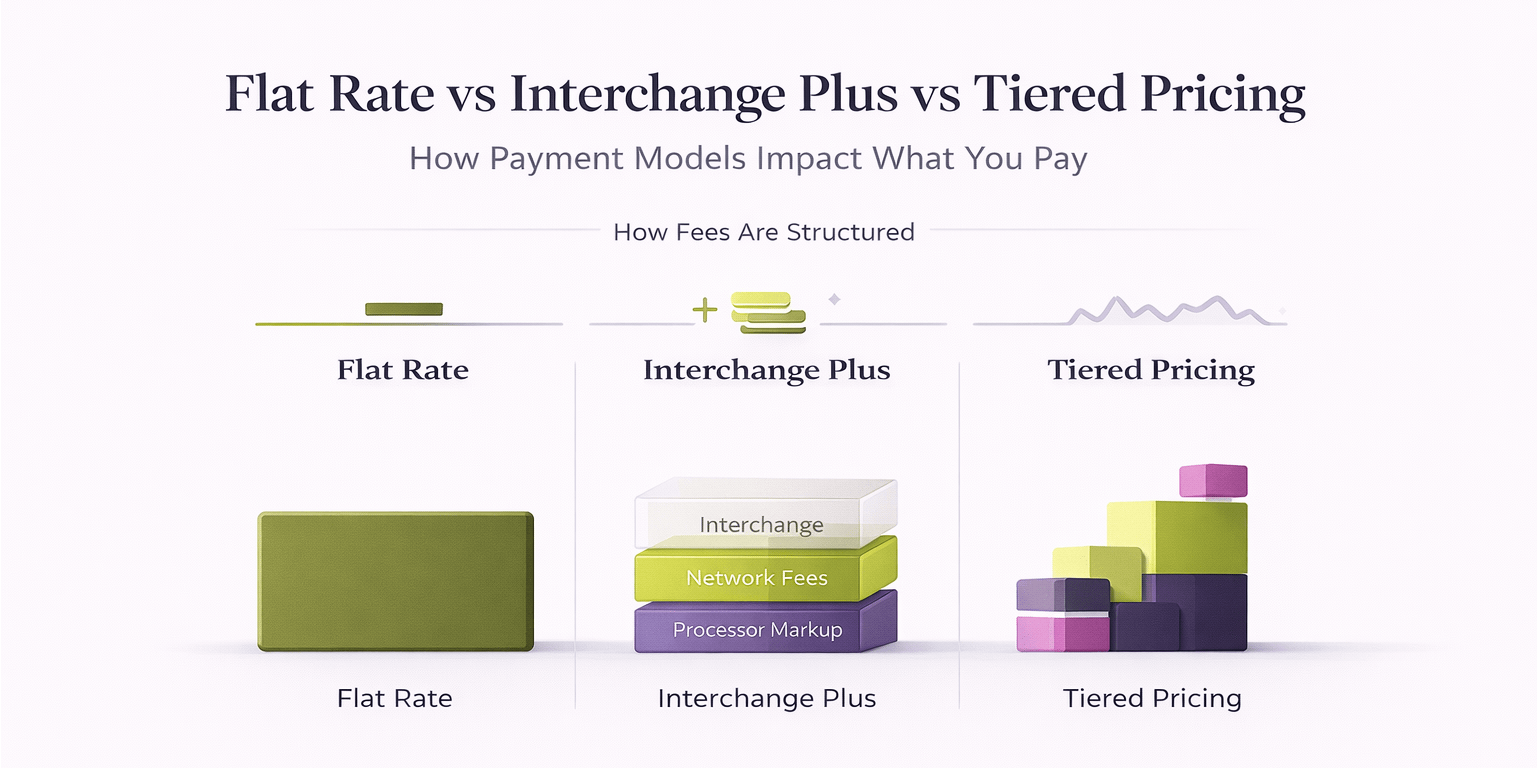
Flat Rate Pricing
Flat rate pricing means every transaction is charged the same percentage.
For example:
2.9% for every transaction.
This is simple, but it requires the rate to be set high enough to cover all possible costs. If your transactions are low-risk or card-present, you may be paying more than necessary. Flat rate protects the processor from loss, not the merchant from overpaying.
Interchange Plus Pricing
Interchange plus separates the real costs from the markup.
You pay:
Interchange
- Network fees
- Small processor markup
This allows lower-cost transactions to stay low. For many businesses, this results in a lower effective rate.
Subscription / Pass-Through Models
Some processors charge a monthly fee instead of a higher markup.
For example:
$49 per month + pass-through fees
This can work well for businesses with predictable volume because the markup is not tied to every transaction. The pricing model you’re on has a major impact on your effective rate.
Why Your Effective Rate Changes Over Time
Another thing many business owners don’t realize is that your effective rate can change even if your quoted rate stays the same.
This can happen because of:
- New fees added
- PCI compliance changes
- Pricing tier changes
- Transaction mix changes
- Card type changes
- Processor adjustments
Sometimes the change is small. Sometimes it isn’t. That’s why reviewing your effective rate every month is important. Not because you expect it to be identical, but because large changes should always have a reason.
If they don’t, it’s worth asking questions.
You Have More Control Than You Think
Many business owners assume their processing fees are fixed. In reality, there is often more control than people realize.
You can influence your effective rate by:
- Changing pricing models
- Choosing the right processor
- Running transactions correctly
- Monitoring fees regularly
- Catching errors early
The challenge isn’t the math. The challenge is figuring out what fees are actually being charged. Statements are not designed to be easy to read. Which is exactly why the effective rate matters.
Why Paygent.ai Exists
Paygent.ai was built to help businesses understand what they’re really paying.
Instead of guessing, you can see:
- Your effective rate
- Your fee breakdown
- Your pricing structure
- Your markup
- Your best-fit processor options
And you don’t need to calculate it yourself. We analyze your statements and show you the numbers clearly, so you can make decisions with confidence.
Transparency should not require a spreadsheet.
It should be standard.
The Only Number That Really Matters
Quoted rates are useful for sales conversations. Effective rates are useful for running a business. If you want to control your processing costs, start there.
Once you know your effective rate, you can finally answer the question every business owner asks:
Am I paying the right amount — or just the amount I was told?
And that’s the point where transparency starts to work in your favor.
Want to know your real effective rate?
Paygent.ai analyzes your processing statements and shows you exactly what you’re paying — and why.
Start your free audit at Paygent.ai